Sooner or later every Kruger plan comes to one choice: the national park itself, or one of the private reserves along its western edge. The animals move freely between the two, because the fences have gone. What changes is who drives, where the vehicle may go, what happens after dark and how you pay.
What is the Greater Kruger?
The Greater Kruger is the band of conservation areas on the Kruger’s western border that have no fence between them and the park. In 2018 SANParks signed a cooperation agreement with these areas to manage the open system together. The signatories included Sabi Sand Wildtuin, Mala Mala, Timbavati, Klaserie, Balule, Umbabat, Thornybush and Manyeleti, along with several community and contractual areas.
Timbavati sums up the Greater Kruger as the fence-free private reserves on the park’s western flank, all inside the 100 000 km² Great Limpopo Transfrontier Conservation Area that spans South Africa, Zimbabwe and Mozambique.
The reserves you will hear about most
- Sabi Sand sits between the Sabie and Sand rivers and calls itself South Africa’s first privately owned nature reserve. The last fences between it and the Kruger came down in 1993. Its landowners run it through the Sabi Sand Wildtuin Association, and guests pay a per-person fee to enter.
- Timbavati covers 556 km² west of the Kruger, with 18 fully inclusive lodges and 4 self-catering camps. Its gate is about 25 km from Hoedspruit, and guests pay a conservation levy per person per night, which the lodges collect for the reserve.
- Balule shares open borders with the Kruger and is home to the Big Five. Kurt Safari’s Ndzuti Bush Camp is here.
- Manyeleti is a 23 750 ha reserve run by the Mpumalanga Tourism and Parks Agency, just south of Orpen Gate. It has open borders with the Kruger, Sabi Sand and Timbavati.
- Klaserie is one of the signatories to the SANParks agreement and lies in the same western block.
How the Kruger National Park works
The Kruger is a public national park of nearly 2 million hectares. Anyone can drive in, stay in a SANParks camp and explore on its tarred and gravel roads, paying a daily conservation fee of R692 per international adult. The rules are the same for everyone, and SANParks enforces them.
- Off-road: not allowed, for any vehicle, including roads marked no entry.
- Getting out: only in designated areas such as camps and picnic sites.
- After dark: self-drivers must be in a camp or out of the park by gate closing. SANParks runs sunset drives that return after dark and night drives that leave at 19:30 or 20:00 for about two hours, and children under 6 can’t join.
- Walks: most camps offer early-morning and afternoon guided walks for up to eight guests, led by two armed field guides, with no children under 12. Longer wilderness and backpacking trails are also run.
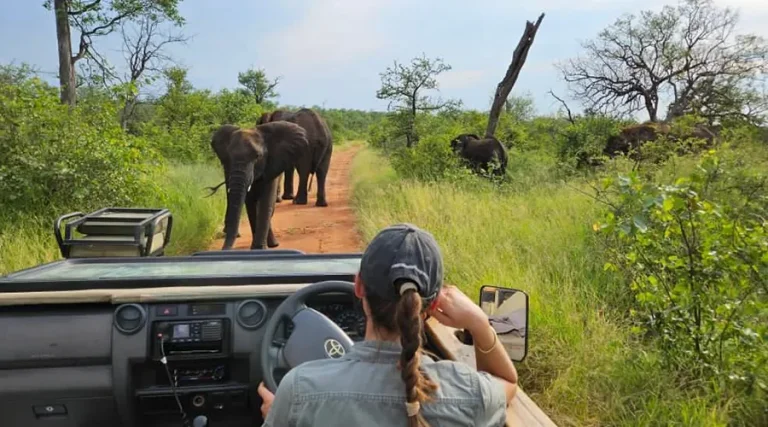
Licensed operators also run guided drives in the park. Kurt Safari’s game drives in the Kruger are in open 4×4 vehicles with its own guides, and most of its group and private safaris start with a sunset and night drive. Our post on bush walks in the Kruger covers walking in more detail.
How the private reserves work
Each private reserve makes its own rules, so details vary from one to the next and sometimes from lodge to lodge. A few examples from the reserves themselves give the flavour.
- Off-road driving: Timbavati’s code of operation stops guides driving off the maintained roads when the ground is wet. Ask your lodge what it allows at other times.
- Vehicles at a sighting: Timbavati limits viewings to two vehicles at a time.
- Night drives: at Ndzuti in Balule, the afternoon drives run into the early evening and return to camp at about 20:00. On Kurt Safari’s photographic safaris in Sabi Sand, the lodges run morning and night drives every day.
- Walks: Big Five walks with an armed guide are included on our Sabi Sand photographic safaris, and are an optional extra at Ndzuti. Manyeleti offers guided bush walks with field rangers.
- Self-drive: Manyeleti is the exception in this list, with a 200 km road network that guests at its main camp can drive themselves.
The reserves also have their own gates and hours. Sabi Sand’s three main gates, Shaws, Newington and Gowrie, open at 05:00 and take their last entries at 22:00, and Timbavati’s public entrance runs from 05:00 to 22:00.
Kruger and the private reserves compared
| What matters | Kruger National Park | Greater Kruger private reserves |
|---|---|---|
| Who runs it | SANParks | Each reserve’s landowners or management, or the MTPA at Manyeleti |
| Fences | None with the reserves on its western border | None with the Kruger |
| Drive yourself | Yes, on public tar and gravel roads | Varies; Manyeleti allows it on 200 km of roads |
| Off-road driving | Forbidden | Set by the reserve; Timbavati bars it on wet ground |
| After dark | Guided sunset and night drives only | Lodges and camps run night drives, for example at Ndzuti and in Sabi Sand |
| Walking | SANParks guided walks from most camps, ages 12 and up | Guided walks at some lodges, such as on our Sabi Sand photographic safaris; an optional extra at Ndzuti |
| Fees | Daily conservation fee, R692 per international adult | Reserve levies or gate fees, such as Timbavati’s per-night levy |
| Where you stay | Rest camps, bushveld camps, satellite camps, camp sites and concession lodges | Lodges and camps inside the reserve |
Where Kurt Safari’s safaris sit
Kruger Safaris, operated by Kurt Safari, has been running safaris from Hazyview since 2008, and most of its range is in the national park itself.
In the Kruger National Park
- Our private Kruger day safaris from Hazyview, in your own open 4×4, from R4 400 per vehicle, with park fees extra.
- Our 3-day classic safari from Johannesburg, from R11 500 per person sharing, and the rest of the classic, luxury and private ranges, staying at Umbhaba Eco Lodge or in SANParks rest camps.
- The Kruger Gate Hotel signature safaris, from R23 760 per person sharing, beside Paul Kruger Gate.
In the Greater Kruger
Our bush camp safari is the 3-day Ndzuti Bush Camp safari in Balule, from R9 900 per person sharing. You sleep two nights in a canvas tent at an unfenced camp where animals come to the waterhole, with two morning drives and two sunset drives that run on after dark. It leaves OR Tambo daily for two guests or more, or you can meet the vehicle at Eastgate Airport in Hoedspruit, and the minimum age is 10.
For photographers, the 4-day luxury photographic safari spends three nights in the Sabi Sand, and the 6-day Wildlife and Scenic safari adds two nights in the Guernsey Private Nature Reserve and a day on the Panorama Route.
If you want long days covering ground on public roads, with the big rest camps for breakfast and lunch, the national park suits you. If you would rather stay in an unfenced tented camp and go out with rangers from your doorstep, a Greater Kruger reserve such as Balule fits better.